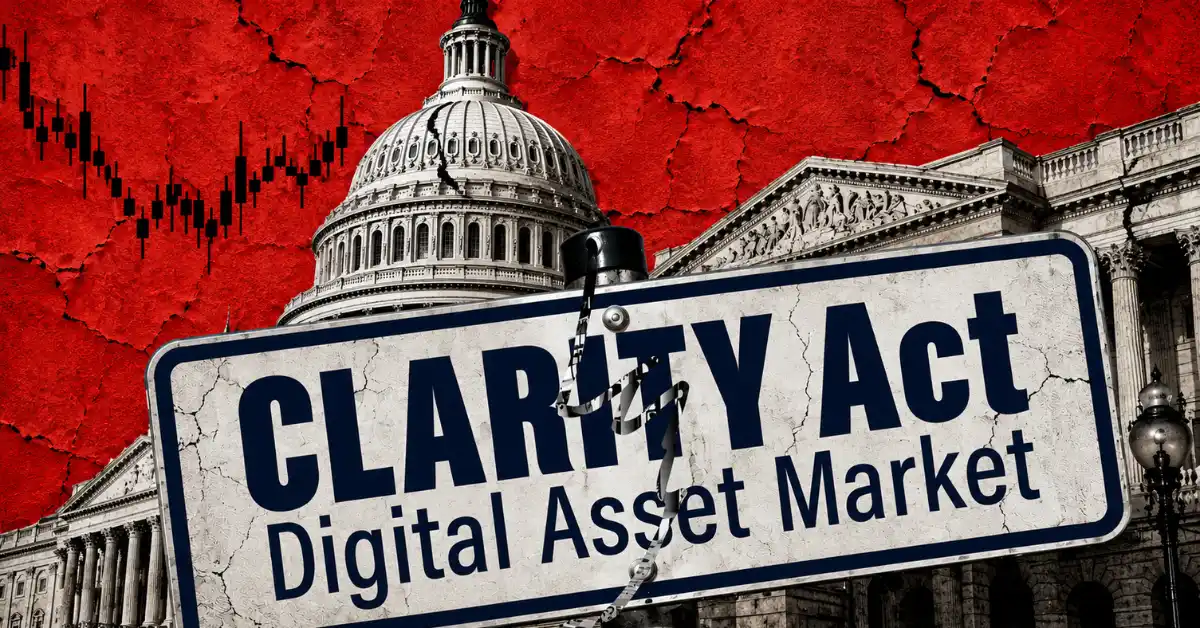
The CLARITY Act has entered another crucial phase after the White House reportedly failed to respond to a bipartisan ethics proposal submitted by Senators Thom Tillis and Ruben Gallego. With the Senate expected to begin its August recess soon, the lack of progress has narrowed the bill’s path forward and increased uncertainty over its future.
According to journalist Eleanor Terrett, the White House has yet to respond to the ethics counterproposal sent last Thursday by Republican Senator Thom Tillis and Democratic Senator Ruben Gallego.
The revised proposal reportedly allows state attorneys general to challenge the Department of Justice if it fails to enforce ethics rules involving crypto activities by federal officials. Democrats had rejected an earlier White House-backed version because it left enforcement solely in the hands of the DOJ.
Gallego said negotiations with Tillis had made progress, while Tillis noted that Democrats had helped shape a stronger ethics framework. However, without a response from the White House, talks remain at a standstill.
The Blockchain Association defended the legislation after the National Sheriffs’ Association (NSA) raised concerns about the bill’s treatment of anti-money laundering (AML), Know Your Customer (KYC), and sanctions rules.
The Blockchain Association highlighted that the legislation includes $3 billion in funding for state and local law enforcement agencies.
Meanwhile, the NSA, which represents more than 3,000 sheriffs and 10,000 public safety officials, argued that the bill creates overly broad exemptions for DeFi protocols and said all crypto businesses should follow the same AML compliance standards.
Despite the ongoing negotiations, Senate Majority Leader John Thune said the CLARITY Act remains part of the Senate’s pre-recess agenda.
Speaking to reporters, Thune said lawmakers still need to complete work on government funding, Russia sanctions, nominations, and the crypto market structure bill. However, he stopped short of confirming when the legislation would reach the Senate floor.
At present, the CLARITY Act is still missing from the Senate’s official schedule, with Monday’s agenda focused only on H.R. 6500. Crypto analyst Ted Pillows noted that if cloture is filed on Wednesday, the earliest procedural vote could take place on Friday.
Coinbase CEO Brian Armstrong urged the Senate to pass the CLARITY Act, noting that 1 in 4 Americans own crypto. He said voters are twice as likely to support candidates who back the bill, regardless of political party, arguing that the legislation would strengthen U.S. leadership in finance, innovation, and national security.
Meanwhile, uncertainty continues to weigh on market sentiment. Polymarket currently places the odds of the CLARITY Act becoming law in 2026 at around 27%, down significantly from above 80% earlier this year.
With only days remaining before Congress breaks for recess, the White House’s response and the Senate’s next procedural move are expected to determine whether the CLARITY Act advances or faces another lengthy delay.
CoinPedia has been delivering accurate and timely cryptocurrency and blockchain updates since 2017. All content is created by our expert panel of analysts and journalists, following strict Editorial Guidelines based on E-E-A-T (Experience, Expertise, Authoritativeness, Trustworthiness). Every article is fact-checked against reputable sources to ensure accuracy, transparency, and reliability. Our review policy guarantees unbiased evaluations when recommending exchanges, platforms, or tools. We strive to provide timely updates about everything crypto & blockchain, right from startups to industry majors.
All opinions and insights shared represent the author's own views on current market conditions. Please do your own research before making investment decisions. Neither the writer nor the publication assumes responsibility for your financial choices.
Sponsored content and affiliate links may appear on our site. Advertisements are marked clearly, and our editorial content remains entirely independent from our ad partners.
PHP has disclosed a new server vulnerability, CVE-2026-115560, only two days after rushing out emergency…
Cardano founder Charles Hoskinson expects Bitcoin to reach $250,000 within the next two years, about…
Quant (QNT) is testing a critical Fibonacci level that could determine whether its recent pullback…
Worldcoin (WLD) is trying to turn a prolonged downtrend into a recovery, but traders still…
Israeli Prime Minister Benjamin Netanyahu said he has asked for a blockchain-based plan to help…
Cosmos (ATOM) could be approaching a critical turning point, but don’t mistake a promising chart…