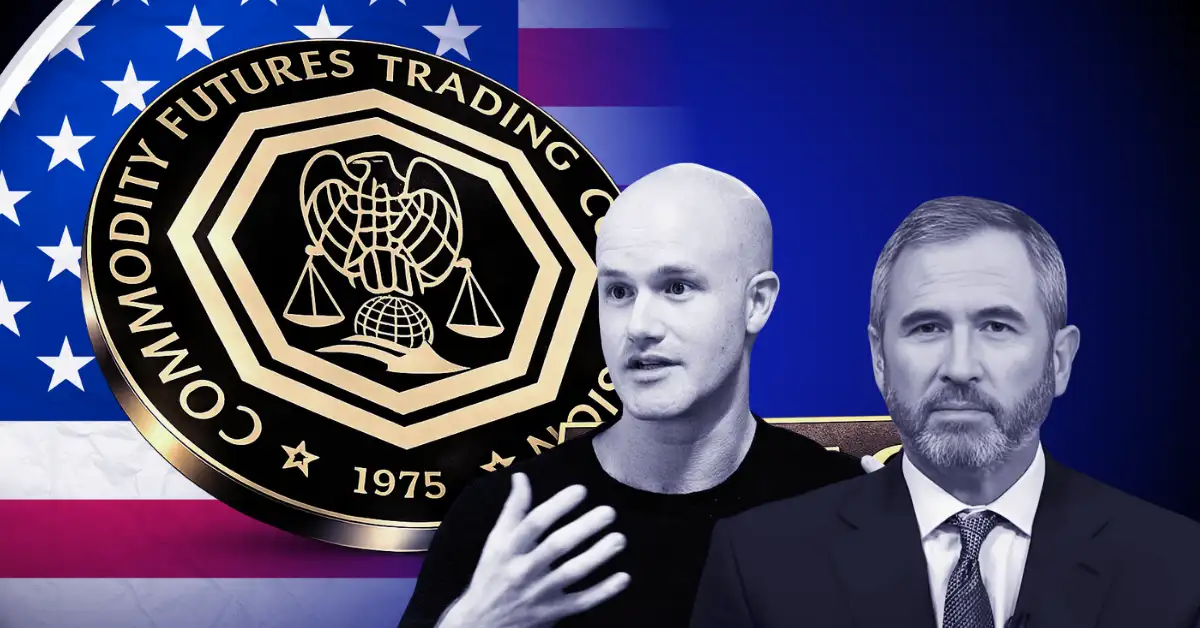
The U.S. Commodity Futures Trading Commission has officially launched its Innovation Advisory Committee, appointing a broad group of leaders from both crypto and traditional finance. The initiative comes under Chairman Mike Selig as the agency positions itself to take on a greater role in overseeing digital asset and derivatives markets.
Among the most prominent appointees are Coinbase CEO Brian Armstrong and Ripple CEO Brad Garlinghouse. Their inclusion signals a direct line between major U.S.-based crypto firms and federal regulators at a time when policy clarity remains a top industry priority.
Selig described the committee as a critical resource for modernizing regulatory frameworks to keep pace with financial and technological innovation.
The 35-member committee will advise the CFTC on innovation-driven developments in financial markets. Its creation reflects the agency’s growing influence in crypto oversight, particularly as it works more closely with the Securities and Exchange Commission on digital asset initiatives.
The CFTC is increasingly viewed as a primary regulator for crypto derivatives and potentially broader digital commodity markets. By expanding the advisory body beyond its previous CEO-level council and nearly tripling its size, the agency is signaling a more structured engagement with industry stakeholders.
Notably, the panel brings together crypto-native leaders and established financial institutions, including executives from Nasdaq, CME Group, Cboe Global Markets, the Futures Industry Association, and the International Swaps and Derivatives Association. The presence of traditional market infrastructure firms underscores how digital assets are becoming integrated into mainstream finance.
Beyond Armstrong and Garlinghouse, the committee includes Uniswap Labs CEO Hayden Adams, Gemini CEO Tyler Winklevoss, Kraken Co-CEO Arjun Sethi, Solana Labs CEO Anatoly Yakovenko, Chainlink Labs co-founder Sergey Nazarov, and Grayscale CEO Peter Mintzberg.
Venture capital representation comes from Chris Dixon of a16z Crypto and Alana Palmedo of Paradigm. The diversity of participants, from decentralized protocol founders to centralized exchange executives, reflects the CFTC’s attempt to gather broad market insight.
The move has drawn positive reactions within the crypto community. Crypto analyst Michael Petricone described it as an example of serious U.S. fintech leadership, arguing that bringing builders into the policy process ensures digital finance develops under American rules and values.
Crypto user Diana called Garlinghouse’s appointment a major win for Ripple and XRP holders. She framed it as giving XRP a seat at the U.S. regulatory table, fueling optimism about Ripple’s long-term regulatory positioning.
While the committee is advisory, its influence could shape derivatives rules, exchange compliance standards, and token classifications. For the crypto sector, the development marks a shift from enforcement-driven headlines toward collaborative rulemaking, a sign that regulatory integration may be entering a new phase.
The CFTC Innovation Advisory Committee is a 35-member panel guiding U.S. regulators on crypto, derivatives, and digital asset policy modernization.
They were appointed to provide industry expertise, ensuring crypto exchanges and blockchain firms have direct input in shaping U.S. regulation.
The CFTC oversees crypto derivatives and is increasingly seen as a key regulator for digital commodities like Bitcoin and related markets.
The panel may influence derivatives rules, exchange compliance standards, and token classifications, shaping future U.S. crypto policy.
Garlinghouse’s appointment gives Ripple representation in regulatory discussions, boosting optimism around XRP’s long-term U.S. positioning.
Franklin Resources Inc. has partnered with the decentralized finance platform Ondo Finance to launch tokenized…
Bitcoin jumped above $71,000 after Trump postponed strikes on Iran, and the entire crypto market…
Bitcoin is showing signs of a short-term recovery, with price action attempting to push higher…
Outset Media Index (OMI), which recently entered the soft launch phase, introduces a standardized way…
In a move that shows the growing convergence between traditional banking and blockchain technology, Monument…
The Bitcoin price has started to stabilize around the $70K region after a sharp pullback,…
