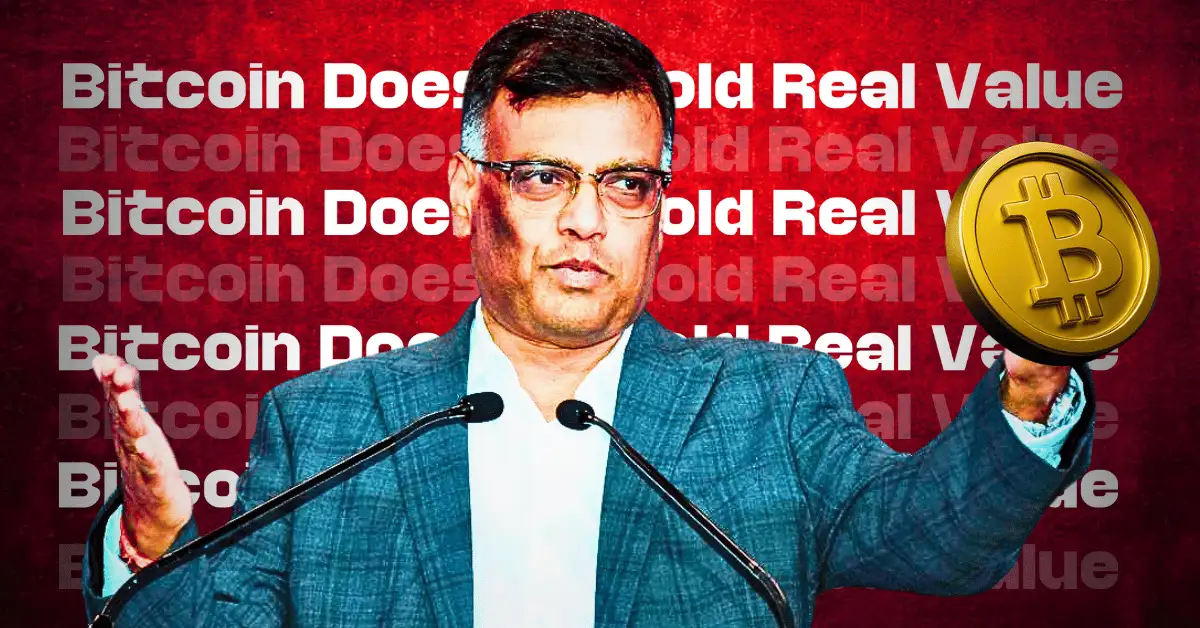
Bitcoin, the world’s largest cryptocurrency, came under sharp criticism after the Reserve Bank of India’s Deputy Governor T. Rabi Sankar said the digital asset has no real value and is driven only by speculation.
Despite raising such concerns from the Deputy Governor, crypto adoption in India continues to grow rapidly in spite of strict taxes and regulations.
Speaking at the Mint Annual BFSI Conclave 2025, RBI Deputy Governor T. Rabi Sankar said Bitcoin should not be seen as money or a financial asset. He explained that while the blockchain technology behind Bitcoin is innovative, Bitcoin itself was only created to showcase that technology, not to hold real value.
Sankar noted that blockchain proved it is possible to transfer digital tokens between unknown parties without needing a trusted middleman. This breakthrough opened the door to many useful applications across finance and other sectors.
However, he stressed that Bitcoin was never meant to represent value in the same way money does.
Further explaining his point, Sankar compared Bitcoin’s price movement to the famous tulip mania of the 17th century. He said Bitcoin’s price exists only because people are willing to pay for it, not because it has any underlying worth.
He added that Bitcoin is not backed by any issuer, promise to pay, or cash flow. Because of this, he believes it does not qualify as real money. He also argues that cryptocurrencies are not true financial assets since they do not earn income or represent ownership in a business.
Meanwhile, he warned that crypto is highly volatile, which is clear as Bitcoin is nearly 30% below its peak, while many other cryptocurrencies are down 40% to 70%.
Despite these strong warnings from the central bank, India’s crypto market continues to expand. The country now has over 100 million crypto users, making it one of the largest crypto markets globally.
However, the government has maintained a cautious approach. In 2022, India introduced a 30% tax on crypto gains along with a 1% tax deducted at source (TDS) on every trade.
These measures were designed to discourage excessive speculation while allowing authorities to monitor activity in the sector.
India imposes a flat 30% tax on crypto gains and a 1% TDS on transfers over ₹10,000, with no loss set-off.
Cryptocurrencies are not legal tender in India but are legal to hold and trade within a regulated tax and compliance framework.
India has a multi-agency approach involving RBI, SEBI, and the Ministry of Finance to oversee various aspects of cryptocurrency.
The Solana price faced significant upward pressure as the broader market sentiments turned bearish following…
The crypto market March 2026 wasn’t driven by shiny upgrades or bullish hype cycles, per…
For years, the knock on traditional banking has been simple: markets move around the clock,…
A tokenization platform closed a $100 million vault for a gold linked stablecoin in under…
The ETH price is booming under the hood while barely moving where it actually counts.…
The crypto market has been facing significant upward pressure ever since Trump announced the re-escalation…
