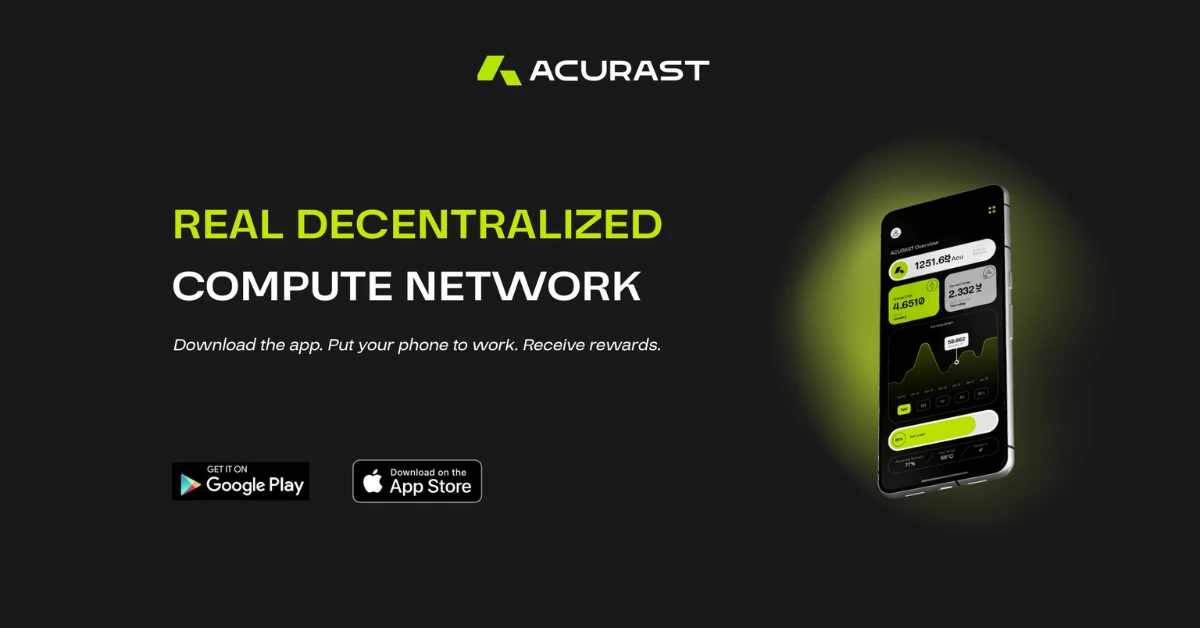
Backed by 119,000+ devices and 360 million transactions, Acurast introduces Staked Compute, aligning smartphone ubiquity with enterprise-grade reliability for decentralized compute.
Decentralized compute and decentralized physical infrastructure network (DePIN) projects have long struggled with reliability and ‘proof-of-hardware’. In the absence of verifiable, device-level assurances, networks have been compromised by virtualized or misreported hardware, resulting in broken deployments and unavailable capacity.
Acurast addresses this head-on by combining smartphone Trusted Execution Environments (TEEs) with a global benchmarking protocol and new stake-based commitments that ensure workloads continue to run.
“Smartphones are already shipping secure hardware that’s world-class, and they’re everywhere,” said Alessandro De Carli, Founder of Acurast. “Staked Compute turns that ubiquity into reliability so that providers make clear availability promises, back them with stake, and earn more when they consistently deliver. No more data centers or intermediaries, just a protocol that pays for performance.”
Under the new design, each participating phone attests to integrity through the device’s TEE, is benchmarked to quantify real capabilities, and can then lock a portion of that capacity for one or more epochs. If a provider meets the commitment, rewards accrue; if they do not, the protocol applies proportional penalties. The result: a service-level mindset for decentralized compute enforced by economics, not a central operator.
“Enterprises want two things above all else: cost efficiency and confidentiality,” said Alessandro De Carli, Founder of Acurast.. “When your workload runs inside a sealed TEE on a consumer device, your sensitive data stays yours. Since comparable phone-class compute cost a fraction of service-class alternatives, Acurast can offer compelling prices without compromising security.”
Different deployments value different resources, so artificial intelligence (AI) inference might prize sustained compute, while lightweight data-fetching or automation tasks might emphasize availability or residential IP characteristics. In Acurast, benchmarking helps match the right jobs to the right devices, while Staked Compute ensures providers get paid for their reliability rather than just their raw speed.
The network’s natural diversity quickly addresses concerns about centralizing in only high-end devices, as many workloads do not require flagship performance. The global smartphone market is broad, spanning every price tier and manufacturer. This heterogeneity is a feature that allows Acurast to allocate tasks across a wide base, improving resilience while minimizing single-class hardware dependence.
This is not ‘mobile mining’ by another name. Mining burns cycles on synthetic puzzles; Acurast routes compute to productive work, whether that be AI and secure data processing or automation and proof generation. Stake-backed commitments ensure quality of service for builders and businesses alike.
Staked Compute is rolling out with Acurast’s latest protocol release, where providers can participate via the Acurast Processor apps. Developers can also target the network via the Acurast Hub, with full details, parameters, and benchmarking methodology documented in the Acurast docs.
China's stock market staged a powerful rally on November 27 after Beijing signalled stronger measures…
Bitmine Immersion Technologies has signalled it will stop buying Ethereum now that its holdings are…
Small-cap crypto tokens are suddenly stealing attention from the wider market, with HAEDAL, KNTQ and…
The US dollar index, which measures the greenback against six major currencies, traded near 103.70…
Wall Street’s Thanksgiving pause is turning into a sharp recovery, with Nasdaq-100 futures jumping more…
US stocks are back in action on Friday, November 27, after the Thanksgiving break, but…